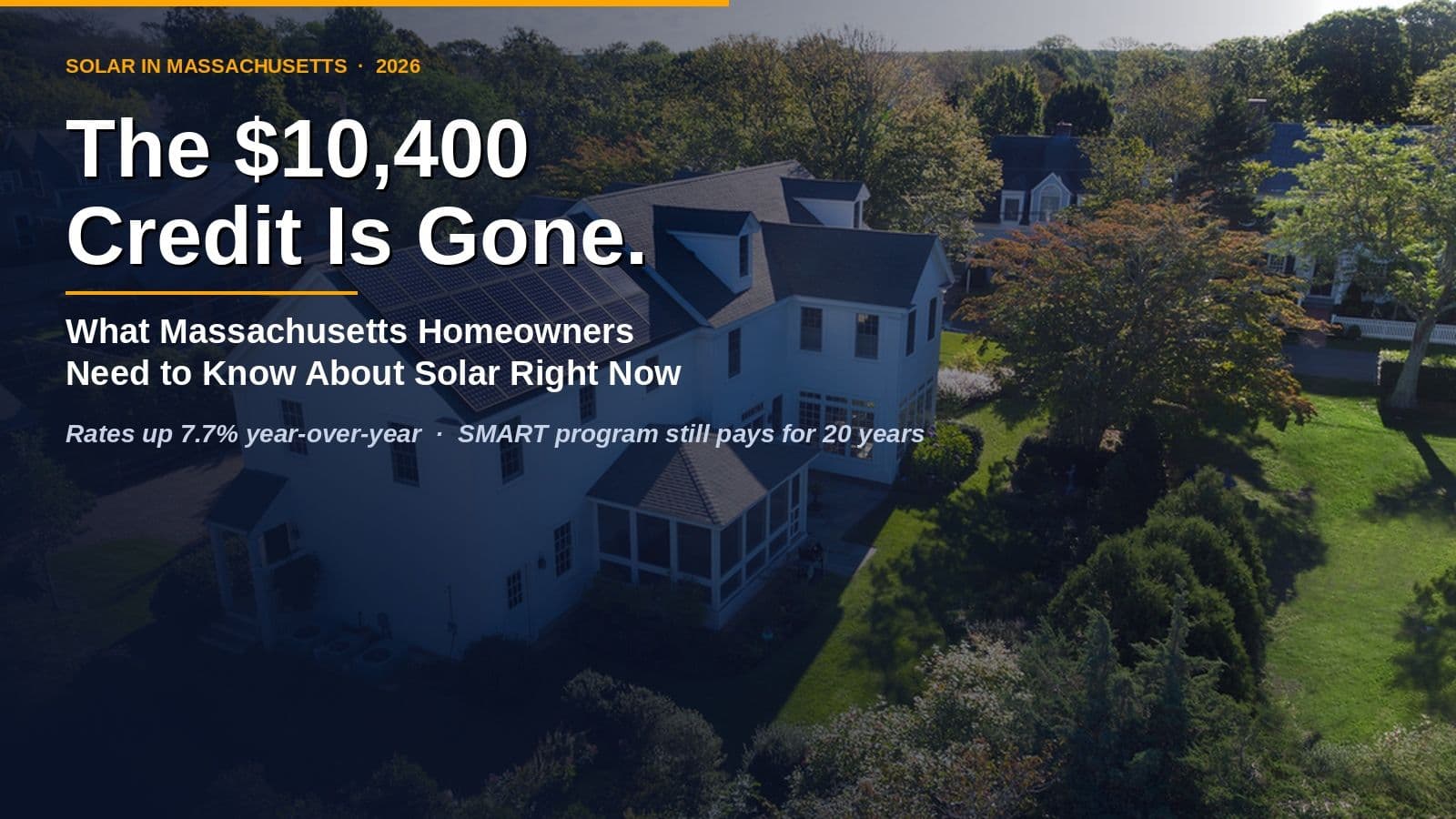
The tax credit that saved Massachusetts homeowners over $10,000 on solar just vanished — and most people don’t know it yet. Your neighbors who installed last year locked in 30% back in their pocket. That window closed December 31, 2025. But here’s the thing: solar in Massachusetts still makes more financial sense than almost anywhere in the country, and the reasons why might surprise you.
Why 2026 Is Still a Turning Point for MA Homeowners
Your Eversource or National Grid bill is not going down. Massachusetts electricity rates hit $0.30 per kWh in 2026 — 67% above the national average — and they’ve risen 7.7% in just the past year. Every month you wait, that bill gets a little larger. The clock isn’t just on solar incentives. It’s on your wallet.
The 30% Federal Tax Credit Is Gone — But Here’s What’s Still Available
The One Big Beautiful Bill Act, signed July 4, 2025, eliminated the residential solar tax credit (Section 25D) for homeowners who buy with cash or a loan. An 11kW system that would’ve generated a $10,400 federal credit in 2024 generates zero in 2026.
But Massachusetts didn’t gut its own programs. You still have a 15% state tax credit (up to $1,000), a full exemption from the 6.25% sales tax (saving $2,000–$2,500 on a typical system), and a 20-year property tax exemption on the increased home value solar creates.
Takeaway: The federal credit is gone. The state stack is alive. Know exactly what you’re working with before getting a quote.
The SMART Program Is Now the Most Important Incentive You’ve Never Heard Of
The Solar Massachusetts Renewable Target (SMART) program pays you for every kilowatt-hour your panels produce — for 20 years. At $0.03/kWh for standard residential systems (and $0.06/kWh for income-eligible households), a typical 8kW system generates approximately $5,760 in SMART payments on top of everything else.
This isn’t a one-time rebate. It’s 240 months of guaranteed income from Eversource or National Grid, separate from your utility savings. SMART rates are set when you enroll, and blocks fill up. The rate you lock in today stays with you for two decades.
Takeaway: Get SMART-enrolled as early as possible. The rate is fixed at enrollment — waiting costs real money.
Lease and PPA Deals Are Having a Moment (Here’s Why)
This is the twist nobody’s talking about plainly: the 30% commercial solar tax credit (Section 48/48E) is still alive for third-party system owners — meaning leasing companies and PPA providers. They can claim it on systems where construction begins before July 4, 2026. They pass those savings to you through lower monthly rates.
If you’re a homeowner who can’t use a large federal tax credit (low tax liability, retiree, etc.), a well-structured lease or PPA may actually put more money in your pocket in 2026 than a cash purchase. This is not always the case — ownership still wins long-term for most — but the math shifted.
Takeaway: Get quotes for both ownership and lease/PPA. The right answer depends on your tax situation. Don’t assume one is automatically better.
Net Metering Is One of the Best in the Country — Use It
Massachusetts law requires Eversource, National Grid, and Unitil to credit residential solar owners at 100% of the retail rate for any excess power sent back to the grid. For Eversource customers, that’s $0.2836 per kWh. For National Grid customers, it’s $0.32 per kWh.
That means when your panels overproduce in July, you’re banking credits worth nearly a third of a dollar per kilowatt-hour to use in January. Most states credit at a fraction of that. Massachusetts credits the full amount — supply charge, delivery charge, all of it.
Takeaway: Size your system thoughtfully. Going too large wastes the benefit; going too small leaves money on the table.
Your Home Is Worth More — And the IRS Can’t Tax It (For 20 Years)
Solar panels increase home value by an average of 4% in Massachusetts. On a $550,000 home — the state’s median — that’s $22,000 in added equity. And under Massachusetts law, that increase is fully exempt from property taxes for 20 years.
You gain the wealth. The tax assessor can’t touch it for two decades. That’s a benefit that has nothing to do with your electricity bill and almost no competitor is leading with it. If you’re planning to sell in 5–10 years, solar is now both an energy decision and a real estate investment.
Takeaway: When running the numbers on solar ROI, include home value increase. Most calculators leave it out entirely.
The 25-Year Picture Still Shows Over $150,000 in Savings
Without the federal credit, the payback period for a Massachusetts solar installation runs about 7–9 years, depending on system size, utility, and financing. Most panels carry 25-year performance warranties. That leaves 16 to 18 years of essentially free electricity after payback.
EnergySage’s current market data puts average 25-year savings for a Massachusetts homeowner at $156,823. That’s before accounting for the near-certain continued rise of utility rates — which have increased every single year since 2020 and show no signs of reversing.
Takeaway: The federal credit’s loss hurt the upfront math. It did nothing to the long-term math.
The Worst Thing You Can Do Is Wait for “Things to Change”
There is no credible energy policy scenario where Massachusetts electricity rates return to where they were in 2020. The state’s dependence on natural gas, ongoing grid modernization costs, and offshore wind investment are structural. Rates go one direction here.
Every month without solar is a month paying Eversource or National Grid at a rate that keeps climbing. The federal credit isn’t coming back for residential purchases anytime soon. And SMART program blocks fill over time, which can lower available rates for new enrollees.
Takeaway: The best time to install was last year. The second-best time is before your next utility bill.
The Bottom Line
The 30% federal credit is gone, and that’s real. But Massachusetts homeowners still have one of the strongest state-level solar incentive stacks in the country, some of the highest electricity rates that make every solar kilowatt-hour more valuable, and 25-year savings projections that remain north of $150,000. If you’ve been on the fence, this is the moment to get a free assessment — not because of a sales deadline, but because the rate increases happening right now are the most compelling argument solar has ever had in New England.
Questions (0)
Loading questions...
Comments (0)
Loading comments...